
What Chinese Scientists Think the World Could Look Like By 2049
Where advanced technology is treated as something to shape, not something to avoid

On December 6, leading Chinese scientists and research institutions gathered in Tengchong, Yunnan, for the annual Tengchong Scientists Forum. At the forum’s flagship session, Yang Yuliang, an academician of the Chinese Academy of Sciences and former president of Fudan University, presented a report titled Tech Predictions and Future Visions 2049.
The report is structured around two complementary parts. First, it lays out ten long-term tech visions spanning AI, robotics, transportation, computing, communications, materials, energy, health, and space and deep-sea exploration. These visions focus on technological capabilities: what kinds of systems might plausibly emerge over the next twenty-five years, and what breakthroughs would need to occur along the way.
Second, the report presents ten “Snapshots from the Future”, which translate those capabilities into concrete domains of social and economic life. Where the visions answer the question “what could exist,” the snapshots ask “what would actually change,” breaking each domain into specific, practical shifts and “industry changes.”
The report also includes a concluding section framed as Three Forward-looking Reflections: (1) embracing intelligent society, (2) Tech for Good with people at the center, and (3) systems thinking and open collaboration.
Yang described the report as a first attempt for China to systematically articulate a forward-looking view of future technology trajectories. While many of the visions remain at an early or exploratory stage, the report frames them explicitly as frontier directions with potential civilizational-scale impact. (This is presented as the authors’ own positioning rather than a settled consensus.)
Taken together, the document is a direct attempt to imagine what “a good life” might look like twenty-five years from now if advances across these domains continue to compound. Notably, it does not shy away from advanced intelligence. The report names AGI and ASI directly and treats them as part of the long-arc trajectory it is trying to map.
My main takeaway
My main takeaway from reading this report is how little explicit pushback, hesitation, or problematization it contains around technologies that often provoke anxiety elsewhere. ASI, advanced gene editing, brain-computer interfaces, and deep human-machine integration are named directly and treated as plausible long-term trajectories. The report does not spend much time debating whether these directions should be pursued at all, nor does it invoke calls to pause, slow down, or avoid certain lines of research.
That doesn’t mean the authors are indifferent to consequences. Rather, the way risk shows up is different. Instead of foregrounding worst-case scenarios, the report repeatedly frames concern around purpose and intent, including questions about human value, privacy, dignity, inclusion, and how to guide convergence responsibly. Ethical considerations show up more as cautions against undermining dignity or widening gaps, alongside an insistence on “technology for good,” even if the boundaries of “good” are not defined in a tightly operational way.
Taken together, the framing suggests an underlying assumption that many of these capabilities will keep advancing, and that the more meaningful debate lies in how they are shaped, governed, and integrated into broader human systems. Whether one agrees with that stance or not, it sets the tone for the rest of the report and helps explain its relatively matter-of-fact treatment of technologies that are often approached with much more visible anxiety.
Below, I’ll walk through the ten tech visions and their associated timelines, followed by a closer look at the ten snapshots and what they suggest about how these technologies are expected to show up in everyday life. The English edition runs 91 pages, so what follows is a condensed summary. You don’t need to read everything in order; skimming is fine. If you want an even shorter version, I’ve also shared a brief thread that focuses only on the ten visions here.
But before getting into the substance of the visions themselves, it’s worth understanding why the Tengchong Scientists Forum is a meaningful venue for this kind of conversation.
Why the Tengchong Scientists Forum matters
The Tengchong Scientists Forum is a relatively new annual gathering that’s clearly trying to position itself as a cross-disciplinary venue for long-horizon scientific discussion. In the report’s own framing, the organizers describe spending the past two years convening scientists, industry experts, and partners at the forum to discuss what 2049 could look like.
It is also explicitly oriented toward international inputs, at least in how it describes its sourcing and process: the report cites interviews and discussions with scientists and experts “from around the world,” and frames the document as an invitation to keep exploring together rather than a closed forecast.
The Tech Predictions and Future Visions 2049 report should be read in that context: not as an official position, but as a collective expression of how one organized group of contributors is choosing to frame the next several decades of technological development.
The Ten Tech Visions, with timelines
Vision 1: From AGI to ASI, and human–machine symbiosis
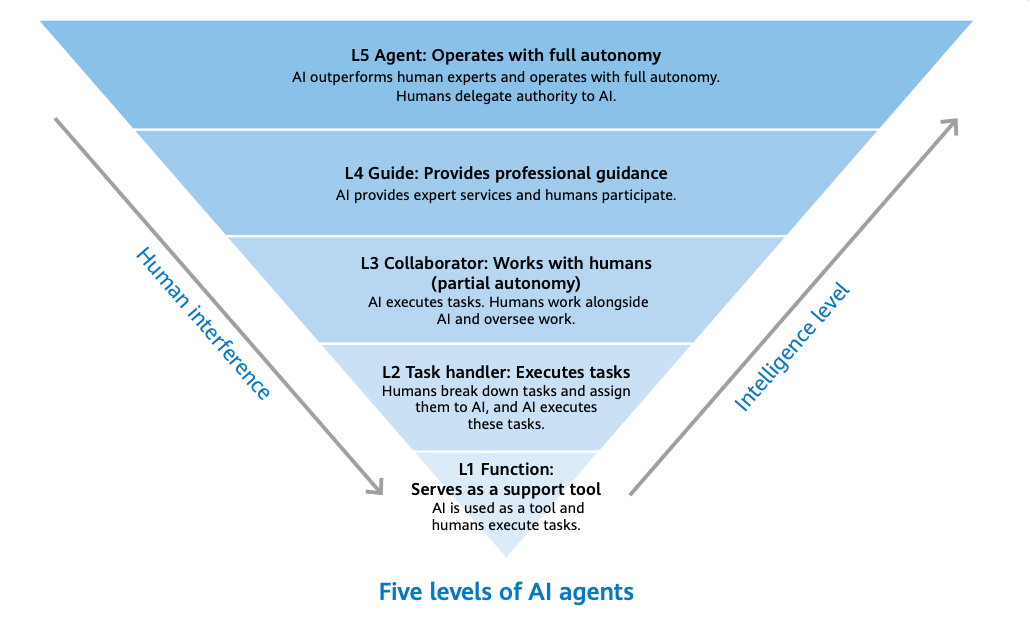
The first vision centers on artificial intelligence progressing beyond narrow or task-specific systems toward AGI and ultimately ASI (artificial superintelligence). The report frames this transition as a means of amplifying human cognition, creativity, and complex decision-making, rather than replacing human agency. A key enabler is bidirectional brain–computer interfaces, which are positioned as a mechanism for tighter coupling between human and machine intelligence.
A central technical claim is that self-evolution is essential to AGI. The report argues that self-evolution cannot emerge in purely abstract or digital environments. Instead, intelligence must be grounded in the physical world, where embodied agents interact with real environments in real time, perceive force, temperature, and spatial constraints, and learn through autonomous exploration, trial, and error in uncertain conditions.
Timeline
Today (L1/L2): Vertical-domain AI agents dominate. Applications proliferate and meaningfully improve productivity, but systems remain narrow and task-bound.
2030 (L3): Early AGI prototypes emerge and become deeply embedded in core industry workflows.
2035 (L4): Partial self-evolution capabilities appear. Employment structures and social division of labor begin to undergo significant restructuring.
2049 (L5): AI reaches ASI, surpassing the human brain and enabling paradigm-level knowledge breakthroughs that would take humans decades to achieve.
Vision 2: General-purpose robots as ubiquitous assistants
The second vision extends the intelligence trajectory into the physical world through general-purpose robotics. Robots are expected to enter both households and industries, functioning as capable assistants and long-term partners in production and daily life.
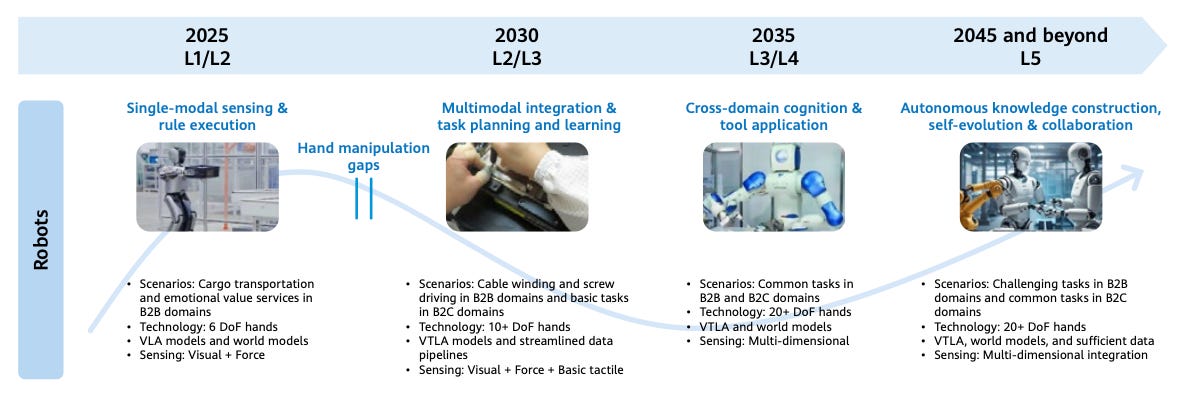
The report identifies three primary bottlenecks: underdeveloped dexterous manipulation, immature tactile sensing, and insufficient training data. It proposes VTLA models (vision, tactile, language, action) as the dominant future architecture, with large-scale deployment enabling a data flywheel that accelerates learning and capability improvement.
Timeline
Today (L1/L2 preparation stage): VLA models dominate. Most demand comes from research institutions, while industrial deployment remains experimental.
2030 (L2/L3): World models and multimodal VTLA systems enter practical use. Robots expand from narrow tasks toward scalable deployment.
2035 (L3/L4): Data flywheel effects become visible. Approximately 30 percent of households begin considering robot purchases.
2049 (L5): General-purpose robots reach full maturity. High-end systems fall to consumer-electronics price levels (several thousand RMB) and become as widespread as smartphones.
Vision 3: Flying cars and air–ground integrated transport
The third vision focuses on flying vehicles as a way to restructure urban transportation and unlock new spatial value. The report emphasizes air–ground integrated traffic systems coordinated by AI, enabling safe and efficient operation across domains.
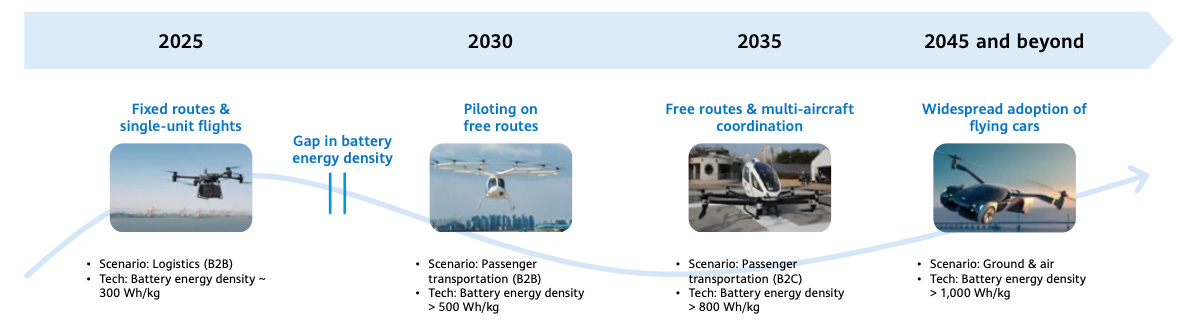
The primary constraint today is battery energy density. The report anchors progress to advances in solid-state batteries and multi-source energy coupling.
Timeline
Today: Low-altitude electric vertical takeoff and landing (eVTOL) aircraft are mainly used for toB logistics. Operations rely on fixed routes and single-aircraft flights, with limited passenger use.
2035: Solid-state batteries reach approximately 800 Wh/kg. New energy systems, including solar–hydrogen–electric hybrids, enter exploratory deployment. Passenger scenarios expand.
2049: Flying cars reach widespread adoption. Multi-aircraft intelligent flight control and full-domain perception systems enable safety comparable to or exceeding traditional ground vehicles.
Vision 4: Mirror world and virtual–physical co-existence
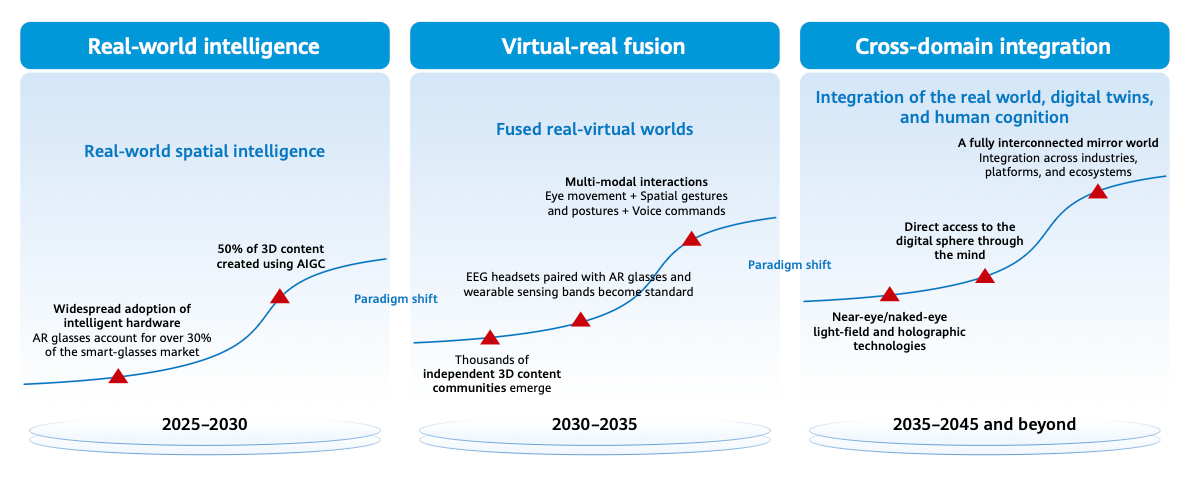
This vision describes the deep integration of mirror worlds, high-precision digital twins of cities, industries, and natural systems, with the physical world. These digital representations enable prediction, simulation, and optimization of real-world systems.
A major bottleneck has been the cost of application development and 3D content creation. The report argues that AI agents and AIGC fundamentally change this cost structure.
Timeline
Today: High development and content production costs limit the scale of digital twins.
2030: Virtual-native social platforms scale alongside real-content platforms. Fully AIGC-built AAA games appear. A next-generation terminal architecture emerges: AR glasses paired with watches or bands and a separate compute unit (display–compute separation).
After 2049: Continuous neural signal capture enables direct interaction between human cognition and digital space. Human–machine interaction shifts from “operation” toward shared perception and emotional resonance.
Vision 5: Universal quantum computing and affordable compute everywhere
The fifth vision is framed less as a single “quantum breakthrough” and more as an eventual shift in how computing is provisioned: compute becomes broadly affordable and available “everywhere,” with quantum capabilities integrated into the wider stack.
Timeline
2030: Rapid growth of agentic AI workloads drives a shift away from von Neumann architectures.
Next five years: Quantum, supercomputing, and intelligent computing increasingly collaborate on complex tasks.
2035: Early “quantum data center” prototypes emerge. Quantum computing begins to materially improve AI and machine learning efficiency.
2049: Fault-tolerant general quantum computing becomes viable. Early “quantum internet” infrastructure forms, triggering a new information revolution.


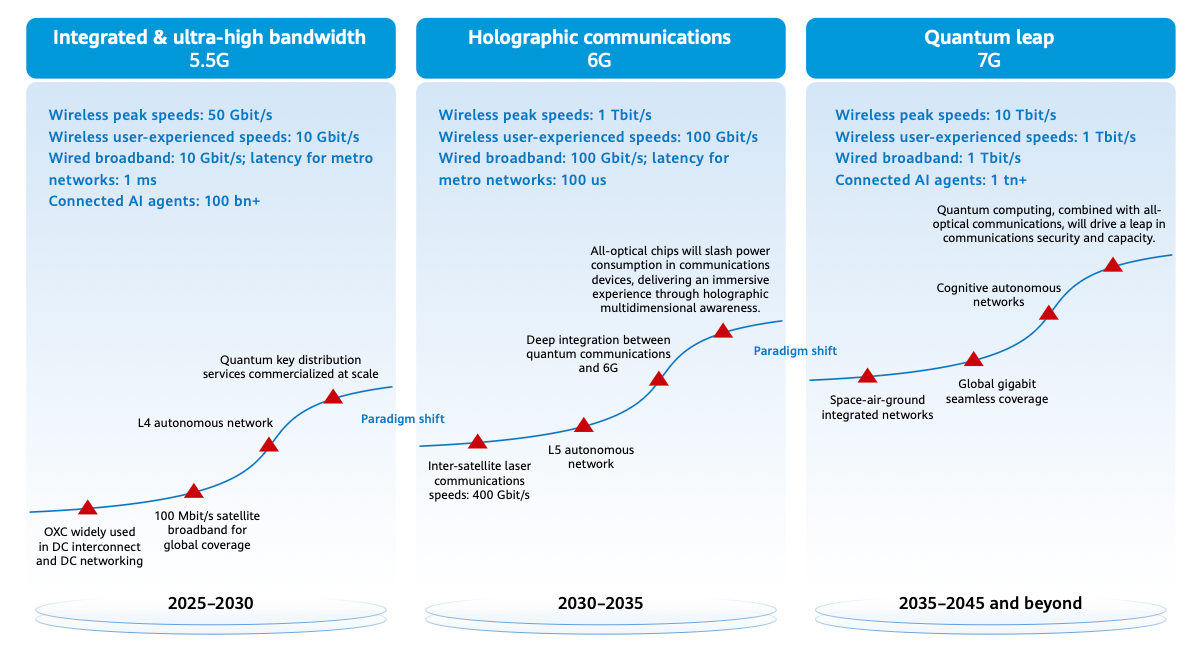
Vision 6: New communications era and the agentic Internet
This vision frames the next evolution of the internet as an agent-centric infrastructure, following the PC internet and mobile internet. Intelligent agents become the primary nodes, coordinating resources, intent, and operations autonomously.
Timeline
2030: Global agent count exceeds 200 billion. Networks can predict and automatically repair roughly 80 percent of common faults.
2035: 6G networks deliver roughly 100 Gbps user experience. Low-earth-orbit satellites enable global coverage. Core networks provide quantum key distribution services.
2049: Agent network nodes reach the trillions. Networks continuously learn user intent and environmental conditions, autonomously generating optimal resource allocation. Space-based internet and terrestrial 7G networks operate seamlessly, with lossless interconnect between data centers and interconnected quantum compute nodes.
Vision 7: Computational materials and room-temperature superconductivity
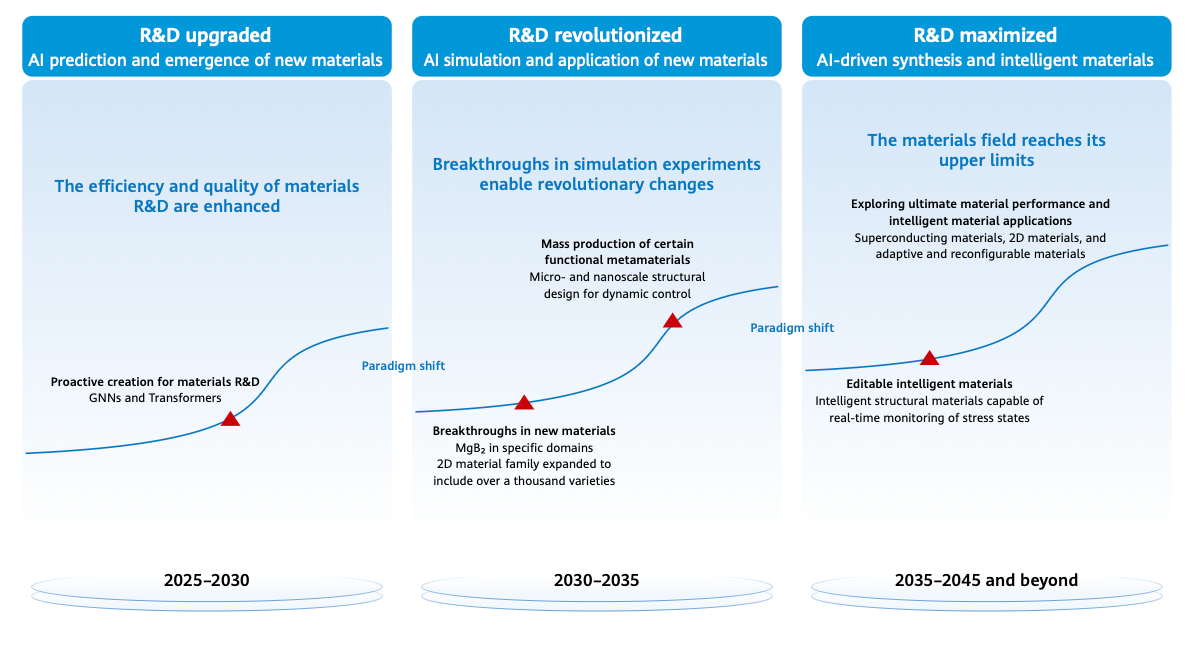
The seventh vision focuses on computational materials science, shifting the field from trial-and-error experimentation toward systematic design. This enables new classes of adaptive and programmable materials and is tied, in the report’s framing, to breakthroughs in room-temperature superconductivity.
Timeline
2035: Ecosystems combining reusable models with high-throughput validation mature. Material development cycles shrink from over a decade to under one year. Programmable materials enter early commercialization in flexible actuators and variable-stiffness exoskeletons.
Discovery of new high–critical-temperature superconductors enters a principle-driven phase. Superconducting power transmission sees partial deployment.
2049: Unified superconductivity mechanisms emerge. Specialized superconductors for different conditions are developed. Energy dissipation and efficiency cease to be dominant constraints in hardware systems.
Vision 8: Commercial nuclear fusion and infrastructure convergence
Vision eight centers on controllable nuclear fusion as the foundation of long-term clean energy abundance. The report also emphasizes the convergence of energy, information, and transportation networks under AI coordination.
Timeline
2035: Fusion achieves Q ≥ 10 energy gain and produces first net electricity. Multiple countries launch demonstration reactor designs. Green hydrogen becomes a key grid-balancing resource.
Energy systems become AI-driven and tokenized, enabling joule-level energy management.
2049: Fusion enters early commercial deployment with grid integration. High-energy industries decouple from fossil fuels. Energy, transport, and information networks operate as an autonomous, coordinated system.

Vision 9: Programmable health through molecular medicine and AI
This vision describes the convergence of molecular medicine, AI, and synthetic biology into programmable health, emphasizing prevention, prediction, and dynamic intervention.
Timeline
2030: Multi-omics molecular diagnostics reach commercial scale. National data infrastructure supports deployment. AI decision assistants generate ranked, personalized intervention options. Gene editing advances from single-point repair to regulatory circuit reprogramming.
2035: Health trajectory prediction shifts disease detection windows 5–10 years earlier. Treatment moves from static protocols to adaptive algorithms. AI-enabled gene editing makes complex traits, including aging-related gene networks, editable.
2049: Healthcare focus shifts from disease control to healthy lifespan optimization. Gene editing evolves into a biological programming language, enabling synthesis of novel functional proteins.
Vision 10: Multi-domain habitation in space and the deep sea
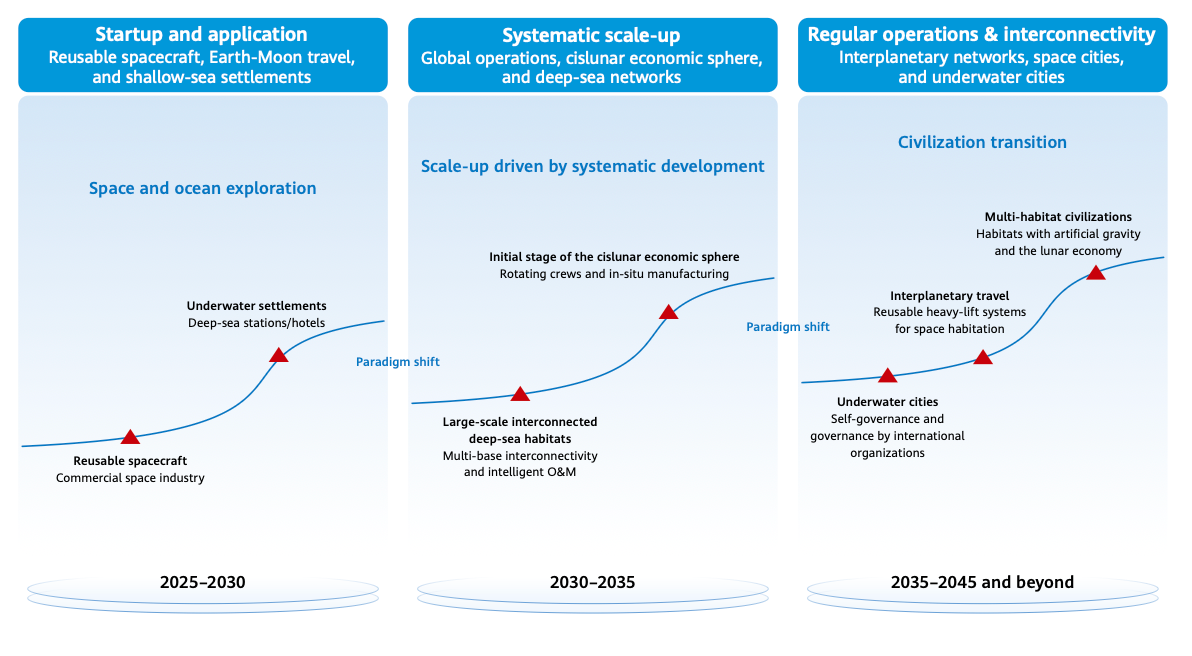
The final vision expands human activity across land, space, and the deep ocean, with the report explicitly framing space exploration as becoming more accessible, habitable, and self-sufficient.
Timeline
2030: Shallow-sea research habitats and underwater hotels operate routinely.
2030s: Energy autonomy becomes critical for undersea cities. Micro-scale nuclear power provides baseload energy. Ocean current energy integrates into undersea grids. Global space transport becomes multipolar. Nuclear thermal propulsion supports rapid crewed transit and heavy cargo. Orbital and lunar infrastructure expands.
2040s: Hundred-person deep-sea cities become operational, maintained by AI and robotic swarm systems. Routine interplanetary travel begins. Lunar industrialization enters a substantive phase. Mars outposts achieve partial self-sufficiency.
The “Snapshots from the Future” and why they matter
In addition to the ten tech visions, the report includes ten snapshots that are meant to ground those ideas in specific areas of social and economic life. The snapshots don’t introduce new technologies. Instead, they sketch how the visions might show up in practice across domains like healthcare, education, transportation, energy, cities, finance, manufacturing, and daily services.
Each snapshot is broken into a small number of defined “industry changes” and specific shifts in how systems are assumed to operate if these technologies mature and scale. Many of these changes remain speculative, and some are clearly optimistic about timing and coordination. Still, this section is useful because it makes the implied applications explicit. Rather than speaking in generalities, it clarifies what people actually mean when they talk about AI-driven healthcare, intelligent cities, or autonomous infrastructure.
Snapshot 1: Healthcare
The health scenario focuses on a shift from reactive medicine toward continuous, predictive, and personalized health management.
From disease treatment to health trajectory management: Health systems move upstream, using multi-omics diagnostics and AI models to predict disease risk years in advance and intervene early rather than waiting for symptoms to appear.
From standardized care to personalized decision-making: AI decision systems assist clinicians by evaluating personalized intervention options based on expected outcomes, replacing static treatment guidelines with adaptive recommendations.
From lifespan extension to healthspan optimization: The goal of medicine shifts toward maintaining functional health over a longer lifespan, integrating gene editing, regenerative medicine, and long-term monitoring.
Snapshot 2: Education
Education is restructured around individual learning trajectories and lifelong adaptation rather than standardized, front-loaded schooling.
From uniform curricula to personalized learning paths: AI tutors and adaptive systems tailor education to individual abilities, interests, and pace, reducing reliance on one-size-fits-all instruction.
From credentialing to continuous capability development: Learning becomes lifelong, with modular credentials and ongoing reskilling replacing fixed degrees as the primary signal of competence.
From knowledge transmission to creative collaboration: As information access becomes ubiquitous, education emphasizes creativity, problem-solving, and human collaboration over memorization.
Snapshot 3: Scientific research
Scientific discovery becomes more automated, collaborative, and accelerated through AI-driven systems.
From human-led to human–AI co-discovery: AI systems generate hypotheses, design experiments, and analyze results alongside human researchers.
From isolated labs to shared research infrastructure: Open platforms and shared experimental resources reduce duplication and lower barriers to participation.
From long cycles to rapid iteration: Simulation, automation, and intelligent experimentation compress discovery timelines across disciplines.
Snapshot 4: Quality of life
Everyday life is increasingly supported by autonomous and intelligent systems that reduce cognitive and logistical burden.
From manual coordination to autonomous services: Scheduling, logistics, and basic services are handled by intelligent agents acting on behalf of individuals.
From productivity focus to life-quality focus: Economic activity increasingly centers on well-being, aging, health, and quality of experience rather than output alone.
From tools to cognitive augmentation: Everyday decision-making is supported by systems that enhance human judgment rather than replace it.
Snapshot 5: Future mobility
Mobility becomes electric, autonomous, and networked, reshaping cities and daily movement.
From ownership to mobility-as-a-service: Personal vehicle ownership declines as autonomous transport services become more reliable and accessible.
From fragmented systems to integrated networks: Ground vehicles, flying vehicles, rail, and logistics systems are coordinated under unified intelligent dispatch.
From car-centric cities to human-centered space: Reduced parking and congestion free up urban land for green space and public use.
Snapshot 6: Manufacturing
Manufacturing shifts from rigid, efficiency-driven systems to flexible, intelligent, and resilient production.
From scale efficiency to adaptive intelligence: AI and robotics enable small-batch, customized, and responsive manufacturing.
From linear supply chains to resilient networks: Digital twins and predictive systems improve robustness against disruptions.
From high-carbon to low-carbon production: Intelligent energy management and new materials reduce environmental impact.
Snapshot 7: Finance
Financial systems become more transparent, automated, and programmable.
From manual oversight to algorithmic governance: AI systems assist with monitoring, risk management, and regulatory compliance.
From opaque flows to transparent transactions: Programmable financial infrastructure enables traceability and real-time auditing.
From blunt policy tools to targeted incentives: Financial mechanisms can be tuned more precisely to influence behavior and outcomes.
Snapshot 8: Advanced energy
Energy becomes clean, diversified, and intelligently coordinated across sectors.
From fossil dependence to clean baseload: Fusion, renewables, storage, and hydrogen jointly support stable energy supply.
From isolated grids to integrated networks: Energy, transportation, and information systems are coordinated under AI management.
From scarcity management to abundance optimization: Energy systems focus on efficient allocation rather than rationing.
Snapshot 9: Cities and environment
Cities and environmental systems are reframed around zero-carbon targets, symbiosis with nature, and resilience.
From emission producers to carbon sinks: Urban systems move past neutrality toward carbon-negative models enabled by carbon capture, new materials, and engineered ecosystems.
From reactive to predictive governance: Digital twins and pervasive sensing shift cities toward proactive management of infrastructure, mobility, and risk.
From brittle to self-healing systems: Buildings, roads, and utilities are designed for autonomous repair and rapid recovery from shocks.
Snapshot 10: Space exploration
Space exploration shifts from government-led initiatives toward broader accessibility and the expansion of human civilization.
From missions to transport networks: Reusable systems and interplanetary logistics reduce the cost of access.
From short stays to long-term habitation: Radiation shielding and life-support systems extend duration and lower health risk.
From resupply dependence to self-sufficiency: In-situ resource utilization and base networks reduce reliance on Earth-supplied materials.
Pulling it together
Looking across the ten visions, a few consistent patterns emerge. None of them are especially surprising on their own, but the report is deliberate in how it connects them and in how it lays out the steps in between.
One recurring theme is physical grounding. Progress in AI, robotics, materials, health, and infrastructure is repeatedly tied to systems that interact directly with the real world: sensing force, temperature, biological signals, and environmental uncertainty. Intelligence, in this framing, does not advance through abstraction or scale alone, but through tighter coupling with physical feedback.
Another is autonomy as a systems property rather than a single breakthrough. Across domains, the report moves from human-operated systems toward systems that can increasingly coordinate, repair, and optimize themselves. This shows up in agent networks, energy grids, healthcare decision systems, and infrastructure. Autonomy is treated as cumulative, emerging from advances across sensing, prediction, and coordination, rather than as a moment of sudden replacement.
A third pattern is convergence. Very few visions hinge on a single technology. Instead, progress is framed as the interaction of multiple systems: AI with energy, computing with materials, robotics with data flywheels, biology with computation. Technologies like fusion, quantum computing, or robotics matter less as standalone breakthroughs than for what they unlock elsewhere.
The timelines are long, and many of the end states are clearly aspirational. But the report consistently tries to surface intermediate milestones, often anchored in the 2030s and 2040s. The specificity varies by domain, and some steps remain conceptual, but the underlying assumptions are made visible. That doesn’t make the forecasts correct, but it does make them easier to evaluate and disagree with.
Finally, the framing remains human-centered, though not in a sentimental way. Health is discussed in terms of extending healthy life rather than simply treating disease. Intelligence is framed as capability amplification rather than replacement. Infrastructure is tied to resilience and coordination more than efficiency alone. Risks and tradeoffs are not the primary focus, but neither are they entirely ignored.
This is ultimately why I found the report worth engaging with. Not because it predicts the future accurately, or because its timelines will hold, but because it makes explicit what is often left implicit: how different technologies are assumed to mature together, what kinds of systems they are meant to support, and what tradeoffs are being accepted along the way. As mentioned, the full report runs 91 pages and references many technical concepts, but it is readable for anyone comfortable with contemporary technology discussions. As a way of seeing how one group of scientists is stitching together a long-horizon technological narrative, it’s best approached with interest, skepticism, and restraint.
Notice how the ethical dimensions in Chinese approaches are intimately grounded in the context of practice, as compared to a Kantian notion of definitive or categorical rules. That is, it is through action in real situations that must shape our ethical dispositions. The west did have such a tradition, by way of Aristotle’s Nichomachian Ethics, but this was pushed aside by Kant. The west could do well to return to its pre-Kantian traditions.
Interesting framing but I think the key axis is missing.
Autonomy doesn’t scale linearly with intelligence. What actually bottlenecks is authority, liability, and recovery when things go wrong.
“L5 agents” aren’t blocked by capability. They’re blocked by who absorbs failure.